Part of our complete guide: Digital Twin Levels, Explore how autonomous twins transform insights into real-world actions, enabling systems to operate, adapt, and optimize independently.
Table of Contents
What Is an Autonomous Digital Twin?
An autonomous digital twin represents the most advanced stage in digital twin evolution.
At this level, the system does more than monitor, predict, or recommend.
It can take action on its own.
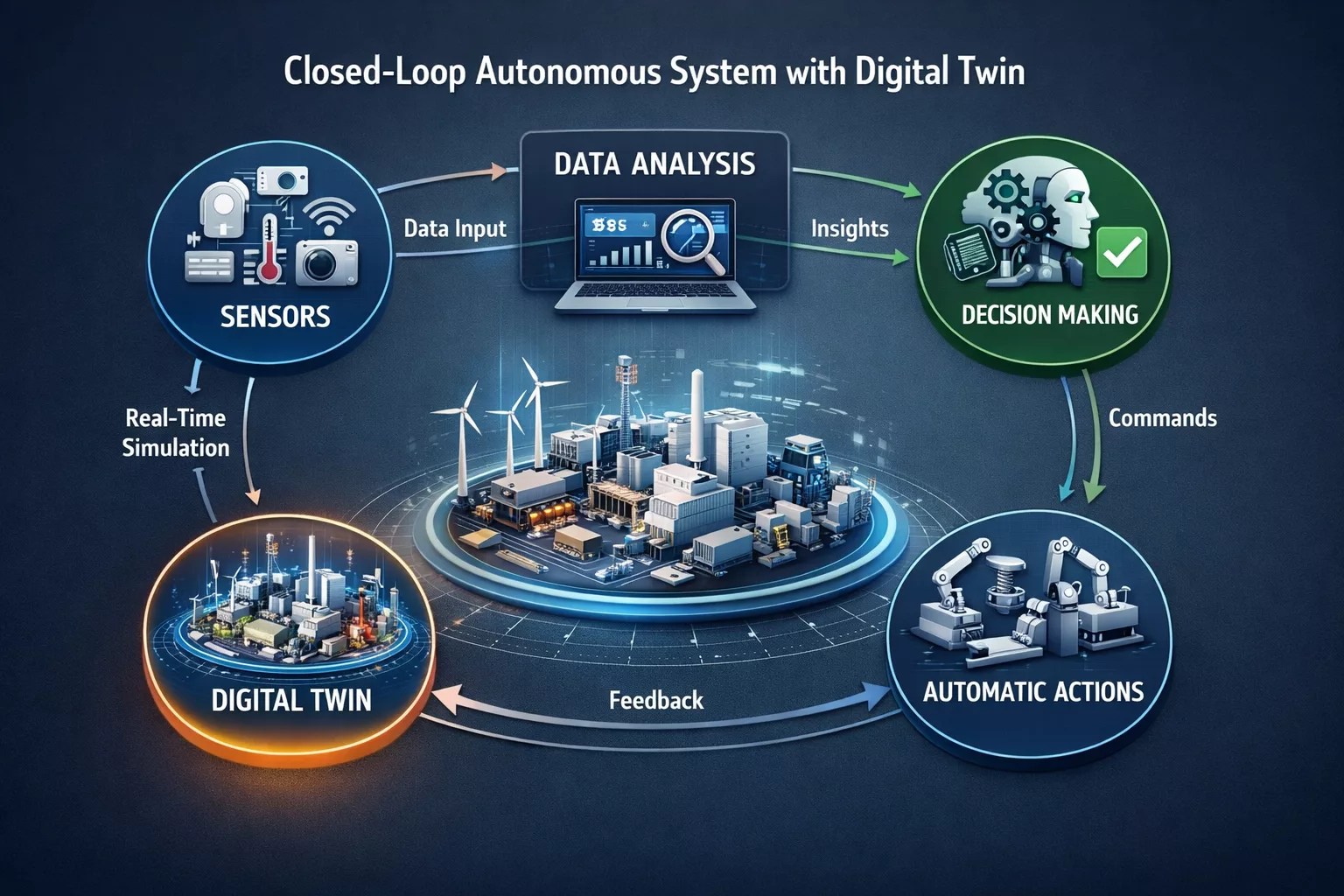
Instead of relying on human intervention, the digital twin continuously:
- Monitors real-world conditions
- Analyzes data in real time
- Decides on the best course of action
- Executes those decisions automatically
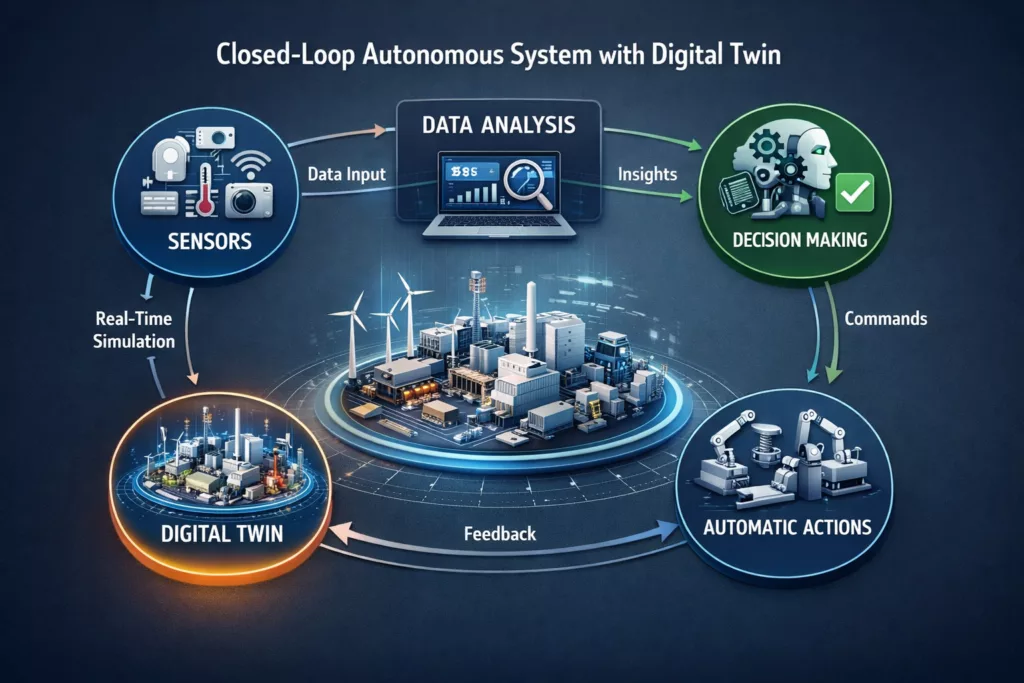
This creates a closed-loop system, where data flows from the physical world into the digital model, and decisions flow back into the physical system.
Why Autonomous Twins Matter
As systems become more complex, manual decision-making becomes a bottleneck.
Even with predictive and prescriptive tools, organizations still depend on people to:
- interpret insights
- choose actions
- implement changes
An autonomous digital twin removes this friction.
It enables systems to:
- respond instantly to changes
- operate continuously without delays
- optimize performance in real time
This is especially valuable in environments where speed, precision, and reliability are critical.
Real-World Example: Smart Industrial Operations
Consider an advanced manufacturing facility using an autonomous digital twin.
The system continuously monitors:
- machine performance
- production output
- environmental conditions
If it detects a potential issue, it does not just raise an alert or suggest an action.
It acts.
For example:
- Adjusting machine parameters automatically
- Rerouting production workflows
- Scheduling maintenance without human input
This ensures operations remain stable, efficient, and optimized at all times.
How Autonomous Digital Twins Work
An autonomous digital twin builds on all previous levels and adds execution capabilities.
1. Continuous Data Flow
Sensors provide real-time updates from physical systems.
2. Predictive Intelligence
The system anticipates potential issues and opportunities.
3. Decision Modeling
Multiple actions are evaluated based on expected outcomes.
4. Automated Execution
The system applies changes directly to the physical environment.
5. Feedback Loop
Results are monitored and used to refine future decisions.
This creates a self-improving system that adapts over time.
Prescriptive vs Autonomous Digital Twin
| Feature | Prescriptive Twin | Autonomous Twin |
|---|---|---|
| Output | Recommendations | Actions |
| Human involvement | Required | Minimal |
| Function | Decision support | Decision execution |
| System behavior | Assisted | Self-operating |
The key difference:
- Prescriptive systems guide decisions
- Autonomous systems execute them
Benefits of Autonomous Systems
Autonomous digital twins unlock a new level of operational efficiency:
Faster response times
Decisions are executed instantly without waiting for human input.
Reduced operational costs
Automation reduces manual intervention and errors.
Continuous optimization
Systems adjust in real time to maintain optimal performance.
Scalability
Large and complex systems can operate efficiently without increasing human workload.
Where Autonomous Twins Are Used
🏭 Manufacturing
Self-optimizing production lines and automated maintenance
⚡ Energy
Grid balancing and automated resource allocation
🚚 Logistics
Dynamic routing and supply chain automation
🌆 Smart Cities
Traffic management and infrastructure optimization
These use cases show how autonomous systems can manage complexity at scale.
Limitations and Challenges
Despite their potential, autonomous digital twins come with challenges:
- High system complexity
- Strong reliance on data accuracy
- Need for robust safeguards and controls
- Trust and adoption barriers
Organizations must ensure that automation is reliable and aligned with operational goals.
Frequently Asked Questions
What is an autonomous digital twin?
An autonomous digital twin is a system that can monitor, analyze, and act on its own without human intervention.
How is it different from a prescriptive digital twin?
A prescriptive twin suggests actions, while an autonomous twin executes them automatically.
Are autonomous digital twins widely used?
They are emerging in advanced industries but are not yet fully widespread.
Do autonomous systems require AI?
Yes, they typically rely on AI and advanced analytics to make decisions.
The autonomous digital twin represents the final step in digital twin maturity.
It closes the loop between data, insight, and action.
Part of the Digital Twin Levels Series
- Level 1: Descriptive Digital Twin
- Level 2: Connected Digital Twin
- Level 3: Predictive Digital Twin
- Level 4: Prescriptive Digital Twin