Part of our complete guide: Digital Twin Levels, After exploring the Predictive Digital Twin (Level 3), we now move to the next stage, how a prescriptive digital twin turns predictive insights into clear recommendations using simulations, scenario testing, and real-world data.
Table of Contents
What Is a Prescriptive Digital Twin?
A prescriptive digital twin is an advanced digital twin that goes beyond monitoring and forecasting.
Instead of only showing what is happening now or predicting what may happen next, it helps answer a more practical question:
What should we do about it?
At this level, the twin uses predictive insights, simulations, and scenario analysis to recommend actions. In other words, it becomes a decision-support layer built on top of the earlier digital twin stages.
This is what makes Level 4 so valuable. It shifts the twin from being a source of visibility to being a tool for guided action.
Watch: Level 4 Prescriptive Twin Explained
Why Prescriptive Twins Matter
Many digital twin discussions stop at prediction. But in practice, organizations often need more than a warning. They need help evaluating choices under real constraints.
That is where a prescriptive digital twin becomes useful.
It can compare multiple pathways, weigh trade-offs, and highlight the option most likely to improve outcomes. That is especially important in environments where decisions are complex, time-sensitive, or high-risk.
In healthcare, that may mean comparing therapy plans.
In manufacturing, it may mean selecting the best maintenance or production response.
In supply chains, it may mean testing policy changes before applying them in the real world.
This aligns with how leading industry sources describe mature digital twins: they are used to simulate situations, support decision-making, test what-if outcomes, and optimize performance. McKinsey
Real-World Example: Hospital Treatment Planning
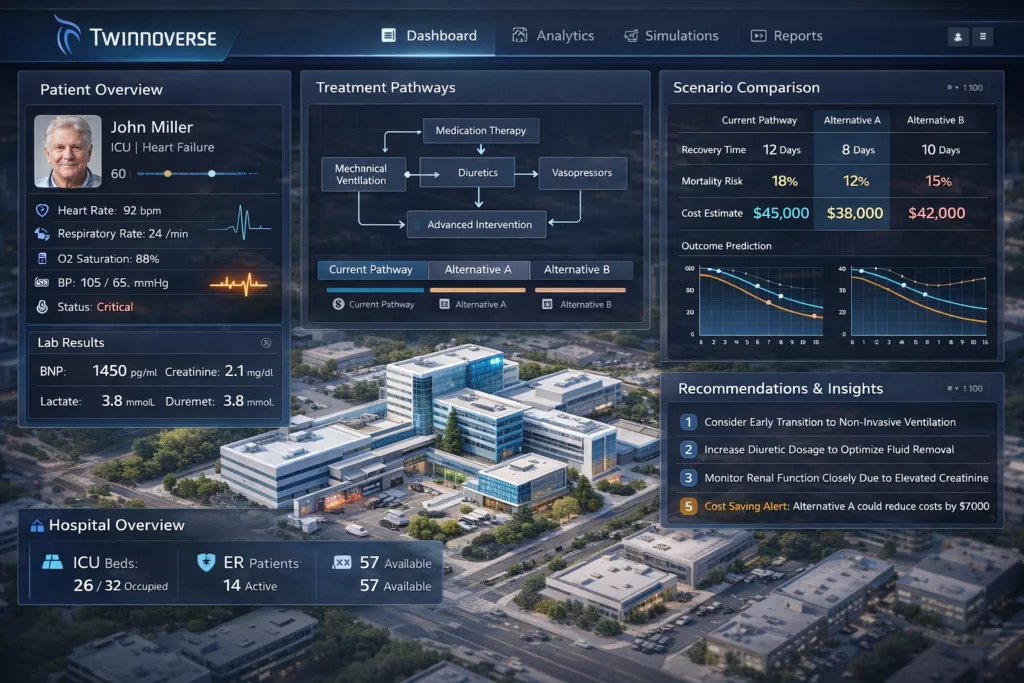
A strong example of a prescriptive digital twin can be found in hospital care.
Imagine a hospital treating a patient with multiple health conditions. A simple dashboard can show current status. A predictive model may estimate likely risks. But a prescriptive digital twin goes one step further.
It can simulate different therapy combinations using:
- real-time patient data,
- prior treatment outcomes,
- disease progression patterns,
- and possible response scenarios.
Instead of presenting one static answer, it helps clinicians compare several possible treatment paths and identify the most suitable option for that patient’s needs.
This matters because care decisions are rarely made in a vacuum. Doctors must weigh effectiveness, side effects, timing, risk, and the interaction between multiple conditions. A prescriptive twin helps structure that decision process with better evidence and clearer trade-offs.
How a Prescriptive Digital Twin Works
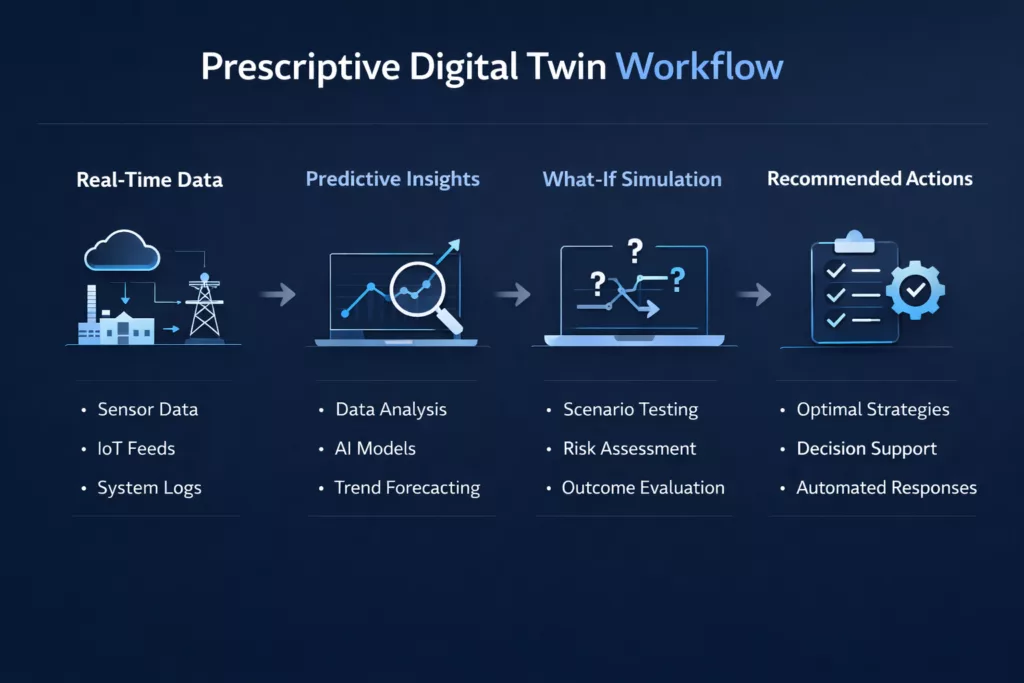
A prescriptive digital twin usually builds on the earlier (you can find all the levels > here) digital twin levels rather than replacing them.
1. Real-Time and Historical Data
The system combines live inputs with historical records, logs, and contextual data.
2. Predictive Modeling
It uses earlier-stage predictive capabilities to estimate likely future outcomes.
3. What-If Simulation
Multiple choices are tested in a virtual environment to see how each path may perform.
4. Recommendation Layer
The system highlights practical next steps based on the strongest expected outcome.
5. Human Review and Decision
In most cases, recommendations still need expert validation before action is taken.
Predictive vs Prescriptive Digital Twin
A lot of readers search for this distinction, so it should be explicit.
| Feature | Predictive Digital Twin | Prescriptive Digital Twin |
|---|---|---|
| Main question | What is likely to happen? | What should we do next? |
| Core output | Forecasts and alerts | Recommendations and action options |
| Main method | Pattern detection and prediction | Simulation, comparison, and optimization |
| Typical use | Predicting failure or risk | Choosing the best response |
The difference is simple:
- A predictive twin improves foresight.
- A prescriptive twin improves decision quality.
Key Benefits of Prescriptive Digital Twins
When implemented well, a prescriptive digital twin can create real operational value.
Better decisions
Teams can evaluate options more systematically instead of relying only on instinct or isolated reports.
Lower risk
Testing choices virtually before acting in the real world can reduce costly mistakes.
Faster response
Instead of spending time debating options from scratch, teams start with evidence-backed recommendations.
Improved outcomes
In sectors like healthcare, logistics, and industrial operations, better recommendations can translate into better performance, lower downtime, or more effective interventions.
Industries Using Prescriptive Digital Twins
Although your video uses healthcare, this concept applies across sectors.
Healthcare
Treatment path comparison, patient-specific recommendations, and therapy planning.
Manufacturing
Simulation of maintenance responses, production adjustments, and process optimization.
Supply Chain and Logistics
Testing inventory, routing, and planning scenarios to reduce cost and improve service levels.
Energy and Utilities
Choosing the best response to equipment risk, demand changes, or operating constraints.
Limitations of Level 4
Even an advanced prescriptive twin has limits.
- It depends on strong data quality.
- Recommendations are only as good as the models behind them.
- In regulated or high-risk environments, human approval is still essential.
- It does not yet represent full autonomy.
That last point matters. A prescriptive twin can recommend an action, but it usually does not execute it automatically. That is the transition to the next stage.
Frequently Asked Questions
What is a prescriptive digital twin?
A prescriptive digital twin is a digital twin that recommends the best course of action by combining predictive insights with simulation and scenario analysis.
How is a prescriptive twin different from a predictive twin?
A predictive twin forecasts likely outcomes, while a prescriptive twin evaluates options and recommends what to do next.
What are what-if scenarios in a digital twin?
What-if scenarios are simulated alternatives used to test how different decisions may affect outcomes before acting in the real world.
Can prescriptive digital twins be used in healthcare?
Yes. They can support treatment planning by comparing possible interventions using real-time and historical patient data.
Is a prescriptive digital twin fully autonomous?
No. In most cases it supports human decision-making. Full autonomous action belongs to a later stage of maturity.
The prescriptive digital twin marks an important shift in digital twin maturity.
It is no longer just about seeing the system or even anticipating problems. It is about using data, simulation, and modeling to make better decisions with more confidence.
That is what makes Level 4 so practical. It turns insight into guidance.
What Comes Next
What happens when a digital twin can move beyond recommendations and take action on its own?
→ Next: Level 5 — Autonomous Digital Twin